
Crank, Wheel, or Brake? Let's hear what The Hot Rod Shop has to say!
Crank, Wheel, or Brake?
Understanding Horsepower Numbers on Your Classic, Hot Rod, or Restomod
At The Hot Rod Shop, one of the most common phrases we hear is:
“I want 500 horsepower.”
That sounds simple—but 500 horsepower means very different things depending on where it’s measured. If you’re planning a classic car restoration, hot rod build, or full engine swap, understanding these differences is critical to building the right combination and getting the most bang for your buck.
Let’s break it down.
⸻
The Three Types of Horsepower (And Why It Matters)
1. Crank Horsepower (Engine HP)
This is horsepower measured at the engine crankshaft, before power goes through the transmission, driveshaft, and rear end.
• Measured on an engine dyno
• No drivetrain losses
• Most manufacturers advertise this number
Example:
An engine rated at 500 HP at the crank has not yet experienced power loss from drivetrain components.
⸻
2. Wheel Horsepower (WHP)
This is horsepower measured at the rear wheels on a chassis dyno.
• Accounts for drivetrain loss
• Most realistic number for real-world performance
• Typically 15–25% lower than crank horsepower
Example:
A 500 HP crank engine may only show 380–425 WHP depending on drivetrain setup.
⸻
3. Brake Horsepower (BHP)
Often confused with crank horsepower, brake horsepower is measured with a brake or load applied to the engine on a dyno.
• Calculated under resistance
• Used for tuning and accuracy
• Similar to crank HP but more controlled
This is why being specific matters.
If you say “I want 500 HP” but don’t clarify where, your build expectations—and budget—can miss the mark fast.
⸻
Why Turbocharged LS Engines Shine
Turbocharged LS engines are kings when it comes to horsepower-per-dollar.
Why?
• Strong factory blocks and internals
• Excellent airflow
• Massive aftermarket support
• Easy to scale power up or down
A properly built turbo LS can:
• Make 500–600 HP at the wheels
• Stay streetable
• Maintain reliability
• Cost significantly less than exotic builds
This is exactly why The Hot Rod Shop has earned the reputation as the LS Swap Kings. Our precision engine swaps and tuning mastery allow us to deliver repeatable, reliable power—not just dyno numbers.
⸻
Engine Comparison: Power vs. Value
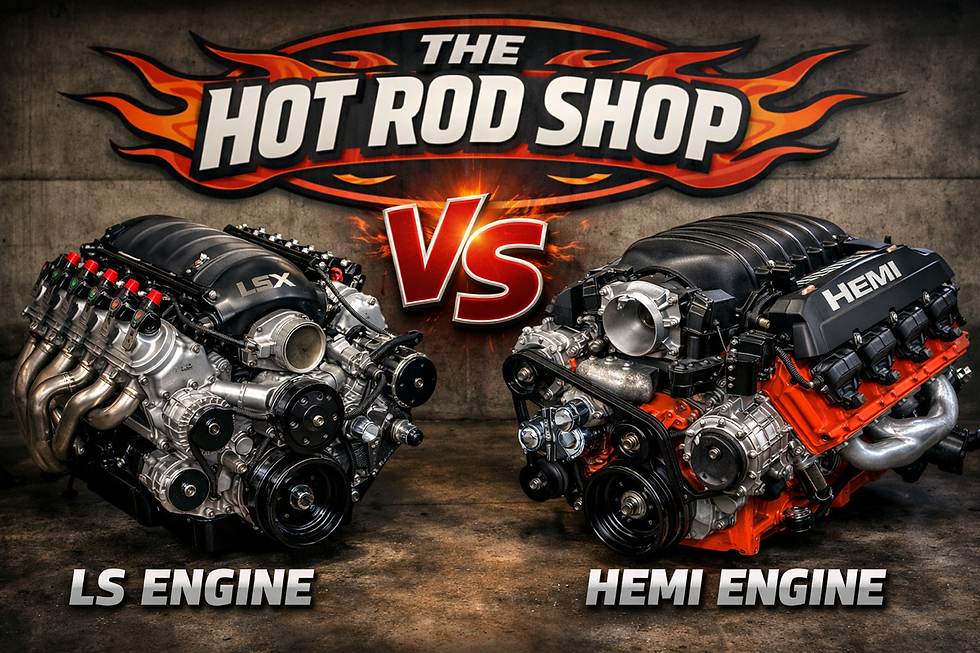
LS Engine
• Horsepower: 430–650+ (naturally aspirated to boosted)
• Pros: Affordable, compact, lightweight, huge aftermarket
• Best for the Buck:
• Why we love it: Easy swaps, scalable power, unmatched value
⸻
Ford Coyote
• Horsepower: 460–500+ stock
• Pros: High-revving, modern tech
• Cons: More expensive swap, wider engine, higher install costs
• Best for the Buck:
⸻
HEMI
• Horsepower: 370–485+ stock
• Pros: Torque monster, iconic sound
• Cons: Costly, heavy, tighter engine bay fitment
• Best for the Buck:
⸻
383 Stroker
• Horsepower: 425–500 HP
• Pros: Classic muscle feel, great torque
• Cons: Less efficient, limited scalability vs LS
• Best for the Buck: (for traditional builds)
⸻
Blueprint Engines: Power with Peace of Mind
We’re excited to now offer Blueprint Engines, which come with:
• Professionally blueprinted assemblies
• Outstanding warranties
• Consistent power output
• Ideal foundations for swaps or upgrades
This gives our customers confidence, reliability, and performance—backed by real coverage.
⸻
Why The Hot Rod Shop Is Known as the LS Swap Kings
We didn’t earn that name by accident.
Precision engine swaps
Expert fabrication
Wiring & drivetrain integration
Tuning that matches real-world driving
Builds that finish strong—every detail dialed in
Whether you want 500 HP at the crank or 500 HP at the wheels, we build it the right way.
⸻
Ready for an Engine Swap?
If you’re planning a classic car restoration, hot rod build, or modern performance upgrade, let’s talk power—real power.
Call the LS Swap Kings today: 336-625-1965
The Hot Rod Shop – Custom Through & Through
When horsepower matters, precision matters more.


Comments